

where does an authentic voice come from?
what ai taught me about finding my voice.

just be yourself.
it’s a phrase i often write in notes, and it’s one of my core philosophies for life as well.
the quest to become more fully oneself and to become more fully human.
it is at the essence of why i write.
the question that sits beneath almost everything i think about is this:
what does it mean to be human?
the recent addition of the ai detector, pangram, to substack has really brought this question into the spotlight for me.
i believe substack has installed it with the goal of having greater transparency around writers using ai. and i do appreciate that.
at the same time, many of the conversations i see people writing about over the past few days seem to revolve around whether the system can be fooled, whether ai can be disguised, and whether readers will know the difference.
those are interesting questions, i appreciate the discussion, and i have even joined in the dialogue.
but they just aren’t the exact questions i have been asking.
i’ve been wrestling with ai since i started publishing on substack.
because the truth is, i may never have started publishing if ai hadn’t given me the confidence to write my first essays.
and this might sound strange, as i had spent years writing previously.
as a teacher, i wrote countless parent emails, long narrative report cards, several plays for my students, and i recently released an album of all original songs.
i even wrote my university thesis in italian, which is my second language.
but i never felt like a confident writer.
whether i was writing in italian or english, i kept my sentences simple because i worried about grammar.
i worried about where to place the commas and about getting something wrong. so i learned to stay inside safe sentence structures because they felt less risky.
then ai came along and for the first time, i felt like i could get the jumble out of my head and onto the page. not just for creative writing, but for more polished essay style writing, without getting stuck on whether every sentence was technically perfect.
my interests in personal development and healing from trauma took me down rabbit holes where i wanted to weave together trauma, neuroscience, psychology, spirituality, and my own lived experience.
i wanted to explore the connections between all of them in a way that felt thoughtful and accessible.
i still do.
but my brain has never thought in straight lines.
it jumps from one idea to another, making connections that feel obvious to me but aren’t always obvious on the page.
i often know what i’m trying to say long before i know how to organize it.
and i now suspect this is all part of my self-diagnosed adhd.
since my mind naturally gathers connections, sometimes i simply need help arranging those connections into a formal essay.
ai is a super helpful brainstorming partner and research assistant.
and i also largely suspect i’m not alone in working this way. i imagine many writers here are also searching for structure and trying to gather thoughts that already existed from their lived experiences into a form another person can follow.
but i must say that i prefer to leave my poetry, channeled writing, songs, creative stories, and the journal entry posts largely untouched by ai, because those pieces don’t want to be touched by a machine’s grasp.
they usually arrive as a stream of consciousness and in these types of creative expression, i want my own language, exactly as it comes out the gate, imperfections and all.
also, since finn died, i have been developing what i experience as mediumship. so when i sit down to write in that way, i don’t feel like i’m inventing the words. it’s more like i hear them by listening inward and then i write them down.
it feels less like being an author and more like being a witness.
which makes me wonder...
where does inspiration come from?
where does creativity come from?
and when i have read so many countless books before becoming the writer i am today, where did the ideas come from?
are they from the books?
or are they from my own mind?
maybe they are part of a symphony of my life…
and maybe they all come from the connections my brain naturally makes between everything i have lived thus far.
i’ve heard many writers who also use ai describe something similar:
they aren’t asking ai what to think, instead they’re trying to weave together everything they’ve already thought, read, questioned, and experienced.
because i often wonder whether the purity of the process is really the point.
or whether the point is getting the truth out of your body and onto the page in whatever way it is able to come through.
so i find myself wondering what actually makes a story ours in the first place…
is it the structure and the scaffolding?
or is it the fact that only one person could have lived it?
i have enormous respect for writers who choose to never use ai at all.
i completely understand that impulse, as i share in it many times as well.
however, i also think every writer has to decide what feels aligned with their own values.
maybe substack’s new ‘pangram’ ai detector simply becomes another layer of transparency, as many readers aren’t just looking for words that sound human, they are also looking for a writer who is willing to be honest about how those words came to be.
i chose to write about this tonight because this conversation feels so personal to me.
i spent much of my life learning to stay silent, and now i’m learning to speak.
if a tool helps me organize my thoughts to do that, i’m grateful for it.
for me the question really boils down to, where does an authentic voice come from, and how do we learn to trust it?
thanks for being here.
~ venus
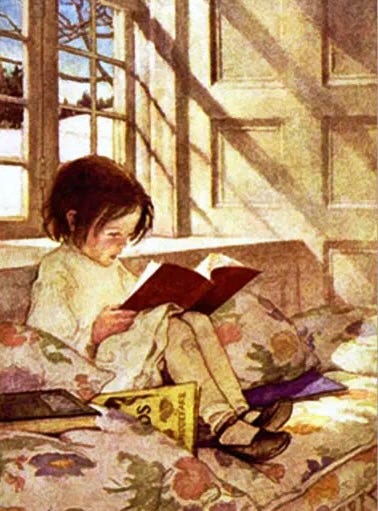
*cover illustration: jessie willcox smith, “picture books in winter,” from a child’s garden of verses, 1905.
i’m a writer, speaker, and musician. i explore what it means to be human through the lens of trauma, neuroscience, and spirituality. i write to reclaim what life asked me to forget and to help others remember what has always been theirs.
I love the personal journey sharing. IT helps me feel connected. Thank you, Venus. Oh, and the authentic voice I use comes from me.
Venus, I read your post and appreciate your questions of where words/ideas come from as you write. Yesterday I heard a NPR interview with the writer of the series, Beef, Lee Sung Jin and the discussion centered around where he got the inspiration for this series, which has won many awards and is up for more Emmy's. I have not seen the series but was so intreguied by Lee's describing of his inspiration for his creation and how it has become a huge success. His talked about his personal growing up trauma and his therapy journey to understand the trauma led his to this creation to write. Apparently at one point before he worked on his trauma he attempted to take his life and this led him to his therapy journey and to learn how to embrace the spiritual and threapuetic healing in his life. But the questions from Terry Gross, centered on where his ideas- authentic voice came from to become an acclaimed writer. The conversation spoke to me like your post did. Both spoke to me of where our authentic creative energies and stories originate from and how to bring them to the page or canvas. Thank your for sharing your process and journey.